.

.
.

Friday, December 27, 2024

Tribute to Elmer & Myrtle Fricke 12/27/2024


For your information, this “Capital Chatter” Dec 26, 2024, column (dateline, Salem, Ore.) about the Frickes was written by Dick Hughes, Linfield Class of 1975.


Capital Chatter: A journalism inspiration and Myrtle's memorial

·         By DICK HUGHES For the Oregon Capital Insider

·         Dec 26, 2024

https://www.oregoncapitalinsider.com/opinion/capital-chatter-a-journalism-inspiration-and-myrtles-memorial/article_7cc73bf2-c464-11ef-9f44-6716a809f8a3.html?utm_source=newsletter&utm_campaign=oregon-capital-insider&utm_medium=email&utm_content=read%20more

In a small but very personal way, Elmer C. Fricke changed the course of Oregon journalism. This is my story.

As a Linfield College student in the 1970s, I regarded Elmer as a curmudgeonly but lively professor of math and computer science.

https://www.oregoncapitalinsider.com/opinion/capital-chatter-a-journalism-inspiration-and-myrtles-memorial/article_7cc73bf2-c464-11ef-9f44-6716a809f8a3.html?utm_source=newsletter&utm_campaign=oregon-capital-insider&utm_medium=email&utm_content=read%20more

At Linfield football games, he was known for shouting “Fumble!” from the stands when the opposing team had the ball. At First Baptist Church, where he and his wife, Myrtle, were in the choir, his wisecracking during sermons elicited many an eyeroll or “shush!” from her.

Elmer also served on the McMinnville School Board, one of many good people who contributed their time and talent without trying to advance a political agenda or launch a political career.

In 1976, editor Jeb Bladine hired me as features editor at the McMinnville News-Register. I was so green, yet so full of myself, that I’m surprised Jeb didn’t fire me five minutes into the job. Instead, I stayed five years.

Jeb taught me how to be a journalist, including knowledge of Oregon’s laws allowing access to government meetings and records:

“The Oregon form of government requires an informed public aware of the deliberations and decisions of governing bodies and the information upon which such decisions were made. It is the intent of the Public Meetings Law that decisions of governing bodies be arrived at openly.”

Among my duties was covering the McMinnville School District. State law limits school boards, city councils and many other government bodies to discussing only certain subjects in closed-door meetings, formally called “executive sessions.”

One evening, I was covering a routine school board meeting. The lawyer for the district told the board to retreat into executive session to discuss a minor agenda item, one that I hadn’t planned to write about.

I don’t remember the topic, but it didn’t qualify for an executive session under the Public Meetings Law. I objected, saying the executive session was illegal.

Quite annoyed, the highly respected McMinnville attorney dismissed my concern, telling the board: “We can discuss that later. Let’s go ahead and do this.”

Then board member Elmer Fricke spoke up: “If Dick says it’s illegal, that’s good enough for me and I’m leaving.”

At that moment I understood the importance of the free press in keeping watch over government. If Elmer left, the board would be without a quorum to conduct business.

Furious, the attorney caved. Board members proceeded to discuss the topic in open session.

That incident fueled my journalistic courage, instilling the awareness and confidence to cite the Public Meetings Law and quote the Oregon attorney general’s handbook whenever necessary.

Not that I am without fault. In a later story, I misstated how much the district paid that attorney. I called him to apologize and said we’d run a correction. “Don’t bother,” he said. “No one pays attention to what you write anyway.”

Public bodies make mistakes. So do I and other journalists, more than we realize but — I believe — fewer than the public assumes. 

I’ve won dozens of journalistic awards through the years. I recall the specifics of only a few. What I do remember are the errors I’ve let creep into my writing. Almost always they’re dumb typos or brain freezes. Rarely do they arise from misunderstandings.

In last week’s Capital Chatter, I twice misspelled Sen. Lynn Findley’s last name despite typing it correctly three other times. I listed 5th District Congresswoman Lori Chavez-DeRemer as a Democrat in “Oregon insiders: Who’s who in and around state government.” 

Argh. It was not a good day.

Meanwhile, trust in the mass media continues to decline. During the 1970s, up to 72% of the public expressed confidence in the media’s ability to report news “fully, accurately and fairly.” That has dropped to 31% as of last month, according to Gallup. What’s even scarier is that many Americans instead trust “information” they get through social media.

As for Elmer Fricke, he not only was my journalistic hero but also an example for how to live.

When my mother died, Myrtle and Elmer became beloved substitute grandparents to our two kids. Our daughter especially remembers her outings with them.

Elmer’s funeral in 2007 brought together people of all ages, swapping heartwarming and often hilarious stories about his impact. I expect a similar multi-generational turnout for beloved Myrtle’s memorial service on Jan. 18, 2025. To me, that is a measure of a life well-lived.

https://www.macyandson.com/obituaries/Myrtle-N-Fricke?obId=34144525

I told the school board story at Elmer’s service. First Baptist was packed, as I later recounted in a March 20, 2008, commentary in the Salem Statesman Journal. I concluded the column with these words:

“Leaving the service, I asked my wife whether she thought many people would attend my funeral, which I hope is a long way off.

“She replied, smiling: ‘It’ll be packed. Half will be glad; half will be sad.’”

Get the best independent source of news and analysis of Oregon state government delivered to your inbox twice a week.

Dick Hughes, who writes the weekly Capital Chatter column, has been covering the Oregon political scene since 1976. Contact him at at
TheHughesisms@Gmail.com, Facebook.com/Hughesisms, YouTube.com/DickHughes or @DickHughes

Wednesday, August 28, 2024

Is Linfield ‘second fiddle?’


Is Linfield ‘second fiddle?’

 (Posted 8/28/2024)

September 2024 issue of CRUSH monthly arts & culture publication produced by Visit McMinnville has an article with photos about “McMinnville’s Art Alley.” Read the article by clicking on two of the photos posted here.

The article is text about with a photo of “greeting postcard-style mural for McMinnville.”

According to the article, “Each letter in ‘McMinnville’ is filled with recognizable local images – the Spruce Goose, a UFO, farmworkers, the Mack Theater, a scene from the local Lunar New Year’s celebration, Serendipity Ice Cream, Buchanan Cellars, and others.”

No mention of Linfield. I wondered, does “any others” include Linfield? I went to the alley to investigate. Photos I shot are posted here. Link to my video clip:

https://youtu.be/FXxmyV8pyMU?si=J7XnpAzqMxX1idNZ

Answer: No Linfield.

In the “old days,” McMinnville was known for Linfield, walnuts, filberts (a.k.a. hazelnuts), Turkey Rama, McMinnville Industrial Promotions, the Linfield campus you drove by en route to the Oregon coast, the Rocket Café, Alf’s Ice Cream, the Blue Moon and others.

At two corners of 99W/Baker Street & Third Street is signage with “hands” pointing to noteworthy places in McMinnville. Linfield used to be there. Not anymore.

If you’ve attended a concert with an orchestra playing, you know it takes many instruments – not to mention musicians, a director and others – to make beautiful music.

McMinnville is, in a sense, an orchestra. It takes many people, places and things making it what it is.

Is Linfield ‘second fiddle?’

….

Postscript -- In case you don’t know the idiom “play second fiddle,” it means “to be less important or in a weaker position than someone else.”


Saturday, February 10, 2024

‘The Plastics Project’ recycling ♻️ 2/10/2024 FBC McMinnville

‘The Plastics Project’ recycling ♻️ 2/10/2024 FBC McMinnville 


(Next recycling event 6/15/2024)

Wednesday, January 17, 2024

Oath administered to newly-appointed Oregon Alien Enemy Hearing Board members including Linfield President William G. Everson (as board chairman) on Jan. 5, 1942, in Portland


PHOTO: Newly-Appointed Alien Enemy Hearing Board Sworn In – United States Attorney Carl G. Donaugh (extreme right) is administering the oath to members of the board when they assembled Monday at the federal court house. Left to right, A. E. Reames, Medford attorney and ex-United States senator; Bishop Benjamin D. Dagwell of the Episcopal diocese here; Dr. William G. Everson, president of Linfield college, McMinnville, who is chairman of the group; State Treasurer Leslie M. Scott; A.E. Clark, Portland attorney, and Donaugh. Oregonian, Tuesday, Jan. 6, 1942.

Monday, January 15, 2024

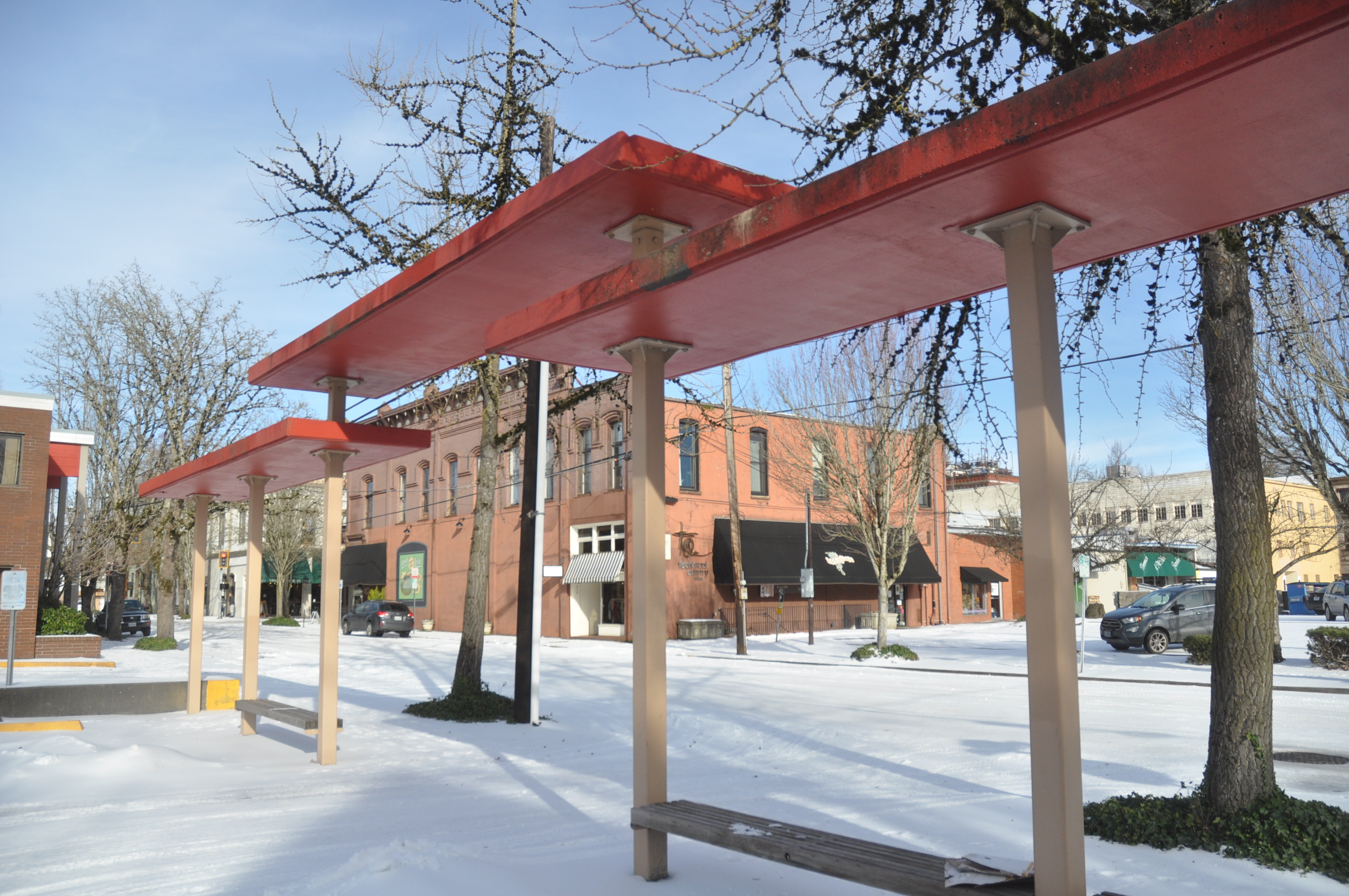
DOWNTOWN McMINNVILLE: ARTISTIC WHATEVER WITH SEATING

DOWNTOWN McMINNVILLE: ARTISTIC WHATEVER WITH SEATING

When the “new” First National Bank of McMinnville (now Key Bank) at 324 NE 3rd (corner of 3rd & Davis) opened in 1964, was this back parking lot artistic whatever with seating there, too? Whether there then (1964) or added later, who designed it? (Mac News photos 1/15/2024)


Read and see photos...

Artist Tom Hardy's 'Ancient Oaks' sculpture on Third Street, downtown McMinnville, on front of National Bank of McMinnville/Key Band

https://mac97128news.blogspot.com/2023/07/artist-tom-hardys-ancient-oaks.html


:::::::::::::::

Salem daily newspaper stories from 1964: -New Bank Opens at McMinnville, Capital Journal
-McMinnville Opens New Bank, Oregon Statesman


Friday, December 29, 2023

In April 2023, a misdemeanor harassment charge against former Linfield Trustee David Jubb was dismissed

--“David Jubb, (a Linfield College grad and) longtime member of the university’s board, resigned as a board trustee in June 2019 after … (a female) undergraduate student trustee, said Jubb groped her in February of that year.”

--“Jubb subsequently was charged in an eight-count indictment that accused him of sexually abusing the four different students in 2017 and 2019. He faced one felony count of first-degree sexual abuse and seven misdemeanor counts of third-degree sexual abuse. He pleaded no contest to two counts of harassment for groping two of the students. Jubb was sentenced in October 2021 to 18 months of probation, ordered to undergo an alcohol abuse assessment and complete 40 hours of community service.”

Source:
Oregonian February 2023, with slight Wildcatville editing.

::::::::::::::::::::::

--“Quietly, in April, a misdemeanor harassment charge against former Linfield Trustee David Jubb was dismissed following his successful completion of an 18-month probation for inappropriate contact with Linfield students. That unreported court action concluded an extended public spectacle that brought unwanted national attention, the professor’s lawsuit, new leadership for the Linfield Board of Trustees, and still-unresolved feelings by many that top-level apologies have been insufficient.”

Source:
Jeb Bladine, president/publisher, McMinnville N-R/News-Register in his "Whatcamacolumn” headlined, “For Linfield, a time of transformation,” in the N-R Dec. 29, 2023, edition.


Wednesday, December 27, 2023

Linfield President Miles K. Davis on lessons learned during his at-times tumultuous tenure

Linfield President Miles K. Davis on lessons learned during his at-times tumultuous tenure

By Suzanne Stevens – Editor, Portland Business Journal 12/26/2023

Miles K. Davis announced plans in November to step down as President of Linfield University. He'll step down on Jan. 1, the first day on the job for interim President Rebecca Johnson.

Davis led the McMinnville-based school through several strategic initiatives during his tenure, including the $14.5 million acquisition of the 20-acre University of Western States campus and a name change from Linfield College to Linfield University, which allowed the school to expand certain programs and degrees. He also helped secure a $10 million gift to build a new science facility.

Davis' tenure was not without turmoil, with controversies involving the handling of sexual abuse and harassment complaints and the firing of a tenured English professor. In a Wall Street Journal opinion piece addressing the controversies, Davis said that "change is hard. And so when you have change, there's resistance."

We checked in with Davis recently to talk about his takeaways from five years in Oregon and what's next. This interview has been edited for length.

 =What's on the agenda when you leave Linfield? 

I am writing a book called "The Rise and Fall of Higher Education." I'm going to start recording podcasts so you'll see some announcements coming out and we're working with the publishers and producers to get that done. I have been asked to consult on a university that's trying to stand up on the African continent. So there is more for me to do. But most importantly is that I want to be able to spend some time with my family (who are on the East Coast).

 =What are you most proud of accomplishing at Linfield?

Well the things that I'm most proud of aren't the things that have made headlines. I'm not sure if proud is the right word, but when I think about it it makes me smile and feel good ... I was hosting faculty my first year here and someone said 'I don't know if you've noticed but we've noticed that our students of color walk a little taller now.' So if my presence in my role made somebody feel better about themselves, and see that what I've accomplished, they can accomplish, I think that's a great start.

 =Any regrets? 

There are people who believe that I did things either to directly or indirectly attack them. I regret that. You can never change people's opinion about how they feel about you because sometimes neither you nor them are aware of exactly what they're reacting to when you say something, so that is something I regret. ... I think from my perspective I was not as sensitive to some things that apparently are very important to Oregonians and maybe to academia and the field in general (when it comes to) process. My life has been dedicated to outcomes. I have a bias for action. I don't like sitting around talking about things for days on end, particularly if your house is on fire. I don't want to debate on which fire extinguisher to use. But I realize that that's inside of me ... and other people don't see it that way.

 =Was your experience in Oregon what you expected when you moved here? 

What I came to understand is that there are a lot of things about me that represent something different. The people who have lived in an environment where they've never been around anyone who was like me. And I mean that on multiple levels, whether it's an issue of pigmentation, whether it's my lived experiences. 

I didn't realize how challenging it would be for some people to hear me when I said things, or that I wasn't fully aware sometimes of what people were responding to ... that it wasn't just about responding to me because some of the actions, both positive and negative, I was getting were from people who didn't know me. I had the chance to be friends with Jesse Jackson Jr., and one of the things that he said to me is appropriate for the situation. 

He said to me that one of the hardest things about being him is that he inherited from his father, Jesse Jackson Sr., both his enemies and his friends, neither of which he has deserved.

 =What's your takeaway from that? 

You can try to adapt to people and culture, particularly if you're trying to be effective within an organizational context, or in any cultural context. You have to adapt to the culture somewhat. You can show up wanting to be as authentic as you want to be. 

However, in certain environments, that authenticity can cause problems for others, and quite frankly, can cause problems for your effectiveness. So you have to understand the environment and context in which you're interacting. As a matter of fact, I was told my strategies would not work because culture eats strategy for lunch. I reject that statement, because sometimes the strategy is to change the culture, but you have to be aware of how it operates and what levers to pull in order to make that happen.

 ….Closer Look…

Miles K. Davis

Title: President, Linfield University (outgoing)

 Previous: Dean of the business school, Shenandoah University in Virginia

 What's next:  Working on a book: "The Rise and Fall of Higher Education," due in 2025.